

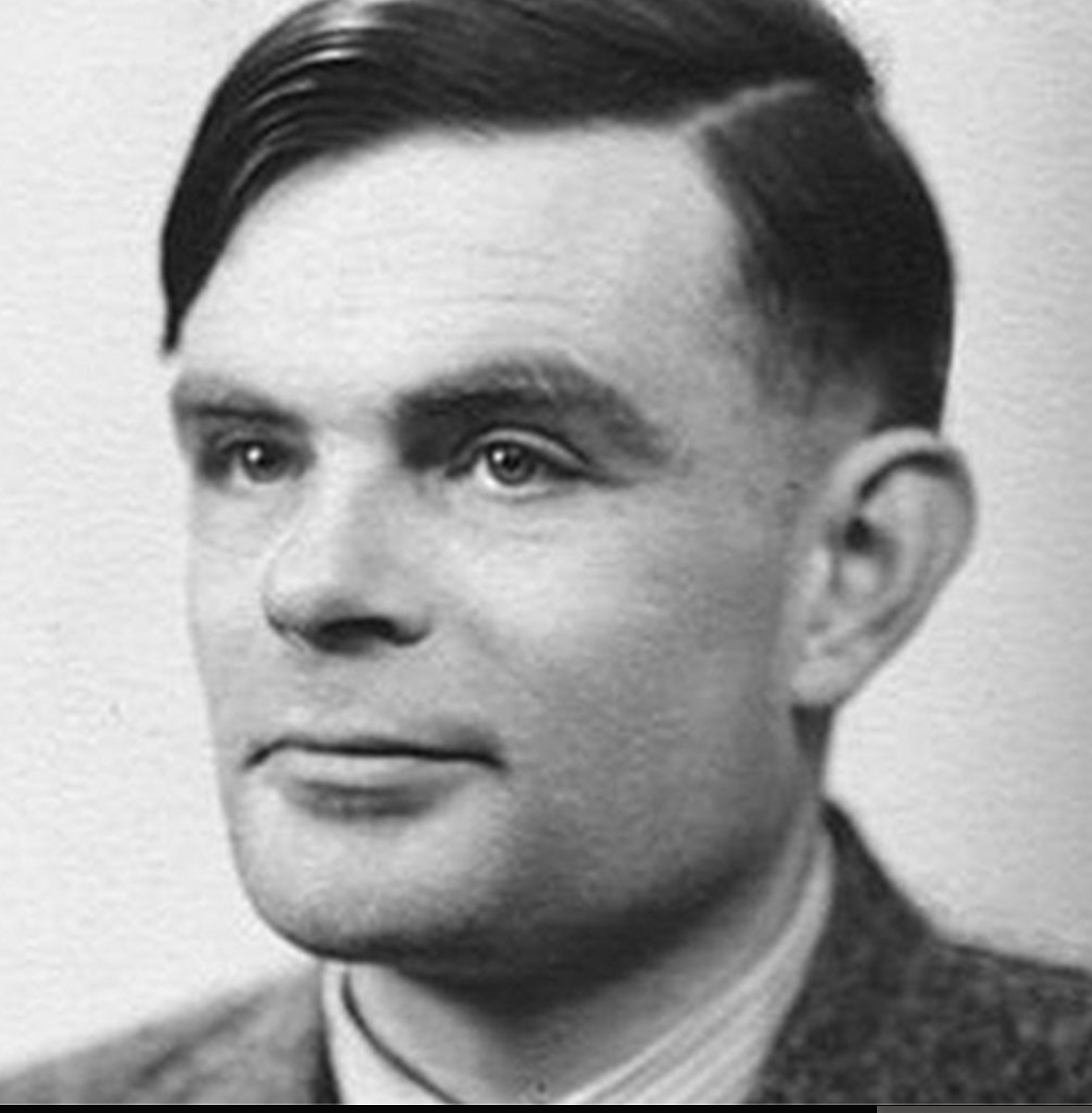
Alan Turing (1912-1954) is best known for the creation of the “Turing machine” which he used to solve, in a masterful way, Hilbert’s decision problem, and also for helping crack the code on intercepted Nazi messages helping the Allies win many major engagements during World War 2. Turing can also be considered a forefather of artificial intelligence with his seminal paper “Computing Machinery and Intelligence” published in 1950. In this section we give a very brief account on his pioneering work on morphogenesis. For an account of most Turing works, we refer to [1].
One of the questions that the biologist D’Arcy Thompson had asked himself was the emergence of similar forms for unrelated organisms, making them inexplicable by purely genetic factors. Turing postulated that there must be some general underlying process obeying physico-chemical laws. He worked on setting up a mathematical model whose purpose wasto account for the “morphogenesis”, that is, the transition from an initial symmetric equilibrium state to a new equilibrium state breaking the initial symmetry and giving a form. This transition was modeled as a “reaction-diffusion” process within the chemical components of the system.
In 1952, Turing published a seminal paper titled “The chemical basis of morphogenesis” [2] in which he described his model and discussed two examples :
- the development of spots like the ones appearing on the pelage of certain animals like leopards ;
- the freshwater polyp Hydra. Initially its tube-shaped body is symmetric until a head with between five and ten tentacles appears at one end of the body.
The general model he proposed describes the interaction between two chemicals he calls “morphogens”. One is an “activator”, which is autocatalytic and so introduces positive feedback. The other is an “inhibitor”, which suppresses the autocatalysis of the activator. Crucially, they must have different rates of diffusion, the inhibitor being faster. In effect, this means that the activator’s self-amplification is corralled into local patches, while the inhibitor prevents another such patch from growing too close by.
At the end of his article, Turing supports the idea that numerical experiments should become a genuine tool in scientific investigation. He writes :
“The difficulties are, however, such that one cannot hope to have any very embracing theory of such processes, beyond the statement of the equations. It might be possible, however, to treat a few particular cases in detail with the aid of a digital computer. This method has the advantage it is not so necessary to make simplifying assumptions as it is when doing a more theoretical type of analysis.”
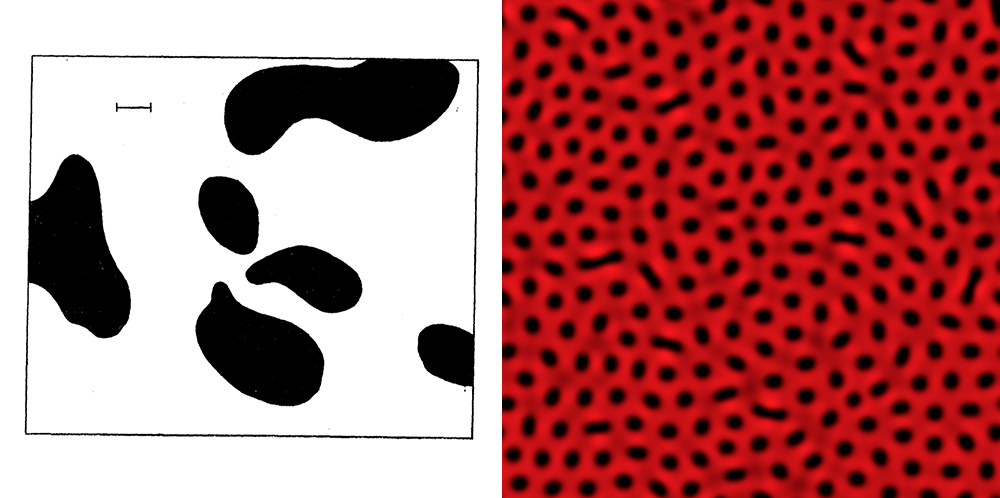
Right : A Turing pattern obtained by the authors. The equations are $\partial u/\partial t=u(v-1)+A \nabla^2\ u, \partial v/\partial t=16-uv+B \nabla^2\ u$ where $u=u(x,y,t)$ is the concentration of the activator at
point $(x,y)$ at time $t$, $v=v(x,y,t)$ that of the inhibitor, and $A,B$ are the diffusion coefficients.
Less known is his work on the problem of phyllotaxis (that is, the arrangement of leaves on a plant stem), which was never published at his time but is included in Turing’s collected works [3]. In that work, he indeed used computer simulations.
Let us mention that it is only in the 1990s that “Turing patterns” were obtained for the first time in a chemistry experiment [4].
We close this section by mentioning that, in March 1946, Turing presented the world’s first complete design for a stored-program electronic computer, ACE. Although Turing had seen the draft report on EDVAC by von Neumann, the ACE design was very different and included detailed circuit diagrams as well as software examples, and a precise budget estimate. Unfortunately, this project did not go as planned [5].