

We end this article with complex dynamics, a field which was pioneered by the French mathematicians Pierre Fatou and Gaston Julia at the beginning of the 20th century. The fact that it became dormant for about sixty years is not by accident : without the visualization of Julia sets provided by computers, it is obvious that nobody had only the haziest notion of what these sets might look like when plotted on the plane.
In the preface of the book “The Mandelbrot set, theme and variations” [1], the mathematician John Hubbard (born in 1945) explained how teaching undergraduate students pushed him to use numerical experiments :
During the academic year 1976-77, I was teaching DEUG (first and second year calculus) at the University of Paris at Orsay. At the time it was clear that willy-nilly, applied mathematics would never be the same again after computers. So I tried to introduce some computing into the curriculum. [...] Casting around for a topic sufficiently simple to fit into the 100 program steps and eight memories of these primitive machines, but still sufficiently rich to interest the students, I chose Newton’s method, applied to a polynomial [2]. for solving equations (among several others). [...] But when a student asked me how to choose an initial guess, I couldn’t answer. It took me some time to discover that no one knew, and even longer to understand that the question really meant : what do the basins of the roots look like ?”
He continues :
“As I discovered later, I was far from the first person to wonder about this. Cayley [3] had asked about it explicitly in the 1880’s, and Fatou and Julia had explored some cases around 1920. But now we could effectively answer the question : computers could draw the basins. And they did : the math department at Orsay owned a rather unpleasant computer called a mini-6, which spent much of the spring of 1977 making such computations, and printing the results on a character printer, with X’s, 0’s and 1’s to designate points of different basins. Michel Fiollet wrote the programs, and I am extremely grateful to him, as 1 could never have mastered that machine myself.”
With the help of Michel Fiollet, he made some numerical experiments to explore these basins. Stimulated by the mathematician Dennis Sullivan who was in residence at IHES [4], he turned to plot various Julia sets : take two complex numbers $z_0$ and $c$ and define the sequence ($z_n$) by recurrence by setting $z_{n+1}=z_n^2+c$. For a fixed value of $c$, the Julia set is the frontier of the set of initial values $z_0$ such that the sequence remains bounded.
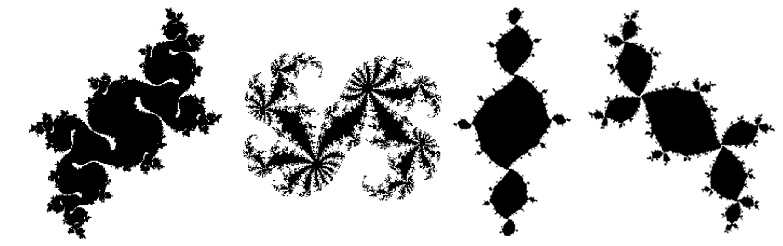
It seems that Hubbard showed his pictures to Benoît Mandelbrot in 1977, during a stay in USA. Mandelbrot told him having often thought about this kind of sets although he had never made pictures of them. Hubbard mentions in the above-mentioned text that the arrival of the Apple II was decisive in making better pictures in an easier way.
Although Mandelbrot (1924-2010) worked at IBM and had access to the best computers available at that time, it is during a stay at Harvard that he obtained for the very first time, in March 1980, a rough image of the set which now bears his name – the Mandelbrot set. He used a Vax computer. Peter Moldave, a teaching assistant, volunteered his services as a programmer. Let us quote Mandelbrot :
[...] I discovered the Mandelbrot set in 1980 while at Harvard, at a time when the computer facilities there were among the most miserable in academia. The basement of the Science Center housed its first D.E.C. Vax 50 (not yet ‘broken in’), pictures were viewed on a Tektronix cathode-ray (worn out and very faint), and hard copies were printed on a ill-adjusted Versatec device. We could only work at night when we had only one competitor for the machine, chemist Martin Karplus. [5]
To obtain this set, one plots the set of all the values of c such that the above- defined sequence remains bounded, starting from z0 = 0 each time. Mandelbrot made much better pictures of it at IBM facilities still with the aid of Moldave and published an article in 1980 reporting this discovery. It is interesting to quote Mandelbrot again [5] :
“In any event, IBM was absolutely not graphics-oriented. I had no roomful of up-to-date custom equipment, only good friends who built a custom contraption that established the state of the art in image rendering.”
The mathematical study really started in 1984 with the work of Adrien Douady and Hubbard who established the fundamental properties of this extraordinary set and named it after Mandelbrot [6] [7]. Hubbard made many numerical experiments to guide their intuition. In 1985, the mathematicians Heinz-Otto Peitgen and Peter Richter popularized the Mandelbrot set by making striking colorful pictures of it [8].
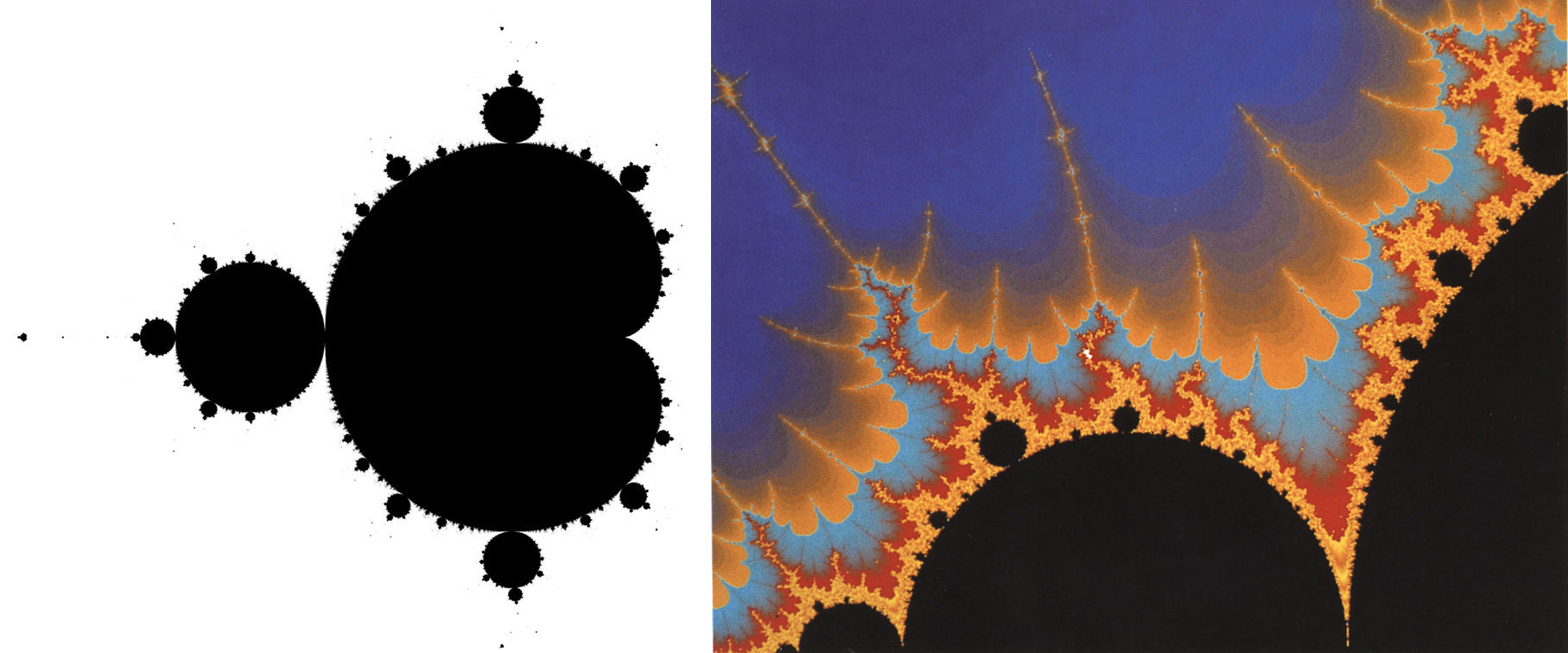
By the way, we recommend the following video-lecture of Hubbard : The Beauty and Complexity of the Mandelbrot Set, dating from 1989. [9]